
Every leadership team I've worked with can tell me where they're headed. Ask five people what winning looks like this year, and in a healthy team, you'll get five matching answers. That's the plan — the goal, the destination, the X on the map.
What almost none of them have is the route — the system underneath the plan: who decides, who's on the hook, and what keeps the plan from dying the moment everyone leaves the room.
I wrote about this a few weeks ago, and it struck a nerve. I worked with an executive team that had real strategic clarity — everyone agreed on where they were headed. What they didn't have was the connective tissue: the cross-functional processes, the decision rights, the cadence of accountability that turns "we agree on the destination" into "we're actually moving towards it." Once we built that layer — a redesigned business development process, cross-functional rhythms and role clarity — they closed $27M of a $30M revenue gap heading into the year.
The plan didn't change. The route did.
A lot of people recognized this pattern immediately, which told me something: the plan is rarely the problem. The gap almost always lives underneath it, in a layer most organizations never name, let alone build on purpose.
What "the route" is actually made of
It's tempting to treat execution as one big, vague problem — "we're just not aligned" or "we move too slow." In practice, I think about it as three layers underneath the plan, each one carrying it a step closer to the destination.
Leadership Alignment comes first: whether the destination actually landed with every leader, not just in the room where it was agreed to. A leader who has to check with you before defending a priority to their own team hasn't really absorbed the plan — they're just relaying it.
Clarity is next — functional scope, role clarity, and decision rights. This is where I see the most expensive, least visible breakdowns. I worked with a team where product and instructional design both assumed they owned user experience decisions — every UX call turned into a week of back-and-forth nobody wanted to have. Once we named who actually held the call, and where everyone else still had real input, two-week decisions became two-day ones.
Infrastructure is the layer closest to daily work — performance scorecards, operating rhythms, work visualization, and information flow. A recurring cadence to check whether the plan is actually happening, not just whether it was agreed to, is what catches drift before a quarter is already lost. And decisions made in a leadership meeting still have to make it back to the people who need to act on them — this is where the signal most often gets lost, not because anyone's hiding anything, but because nothing's carrying it downstream on purpose.
Individually, none of these sound dramatic. Together, they're the difference between a plan that survives contact with a real quarter and one that quietly falls apart the first time something doesn't go according to script.
Naming the whole system
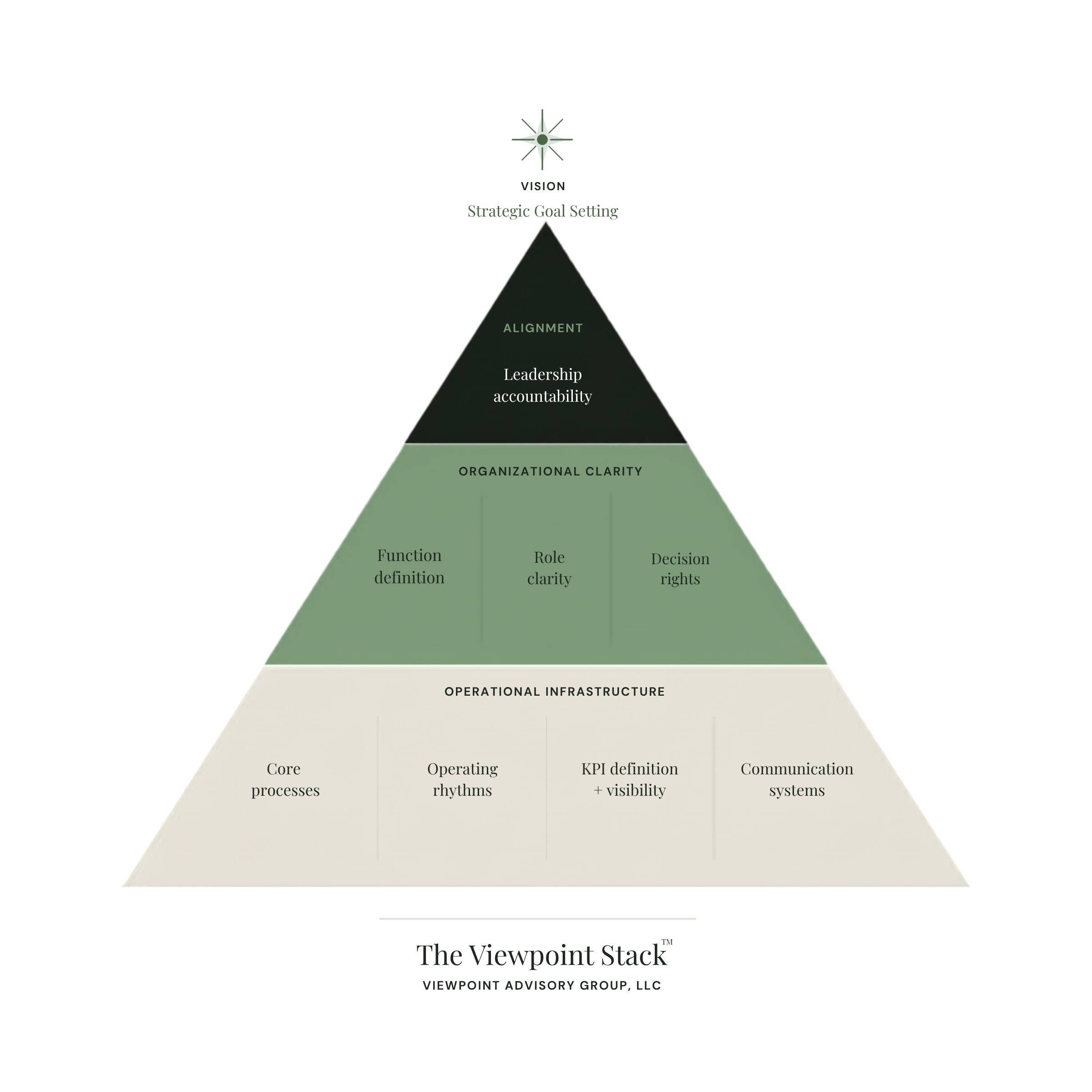
After years in product management, I can't help but approach this work from a product mindset. I've come to believe organizations should be built the way good products are — with intention, iteration, and a view of the whole system, not by accident. Nobody assembles a product by bolting on whatever feature seems most urgent that week and hoping it all holds together later. And yet that's exactly how a lot of organizations get built: a role added here, a process added there, each one solving the most immediate problem, with no one stepping back to check whether the whole system still works.
It's also where the name comes from. Everyone wants the view from the summit. But you don't get there by wanting it — you get there with solid ground underfoot and a route mapped before you climb. The view is the destination. The ground and the route are what actually get you there.
I call the whole system, top to bottom, the Viewpoint Stack™:
- VisionStrategic Plan
- AlignmentLeadership Accountability
- ClarityFunctional Scope, Decision Rights, Role Clarity
- InfrastructurePerformance Scorecard, Operating Rhythms, Work Visualization, Information Flow
Most strategic planning stops at the top layer. The offsite produces a plan, everyone nods, and the assumption is that the rest will follow. It rarely does — not because people don't want it to, but because nobody built the three layers underneath it on purpose.
The teams that actually execute well didn't get there by having a better plan. They got there by treating the layers below it as real infrastructure, worth designing with the same intention as the strategy itself.
If you're heading into 2027 planning
Don't stop at the destination. A plan without a route is just an expensive way to describe where you wish you were. If you're already sensing the gap — a team that agrees on where it's going but somehow isn't moving together — that's usually not a sign the plan is wrong. It's a sign the route was never built.
I've built a short instrument called The Ground Check™ that walks a team through the Stack directly — eleven questions, one for each layer, answered anonymously by the team, showing exactly where everyone agrees and where they don't.
I'm opening up early access to The Ground Check for a few teams this fall. Curious what your own team's route actually looks like? Drop your email below and I'll reach out when it's ready for you.